
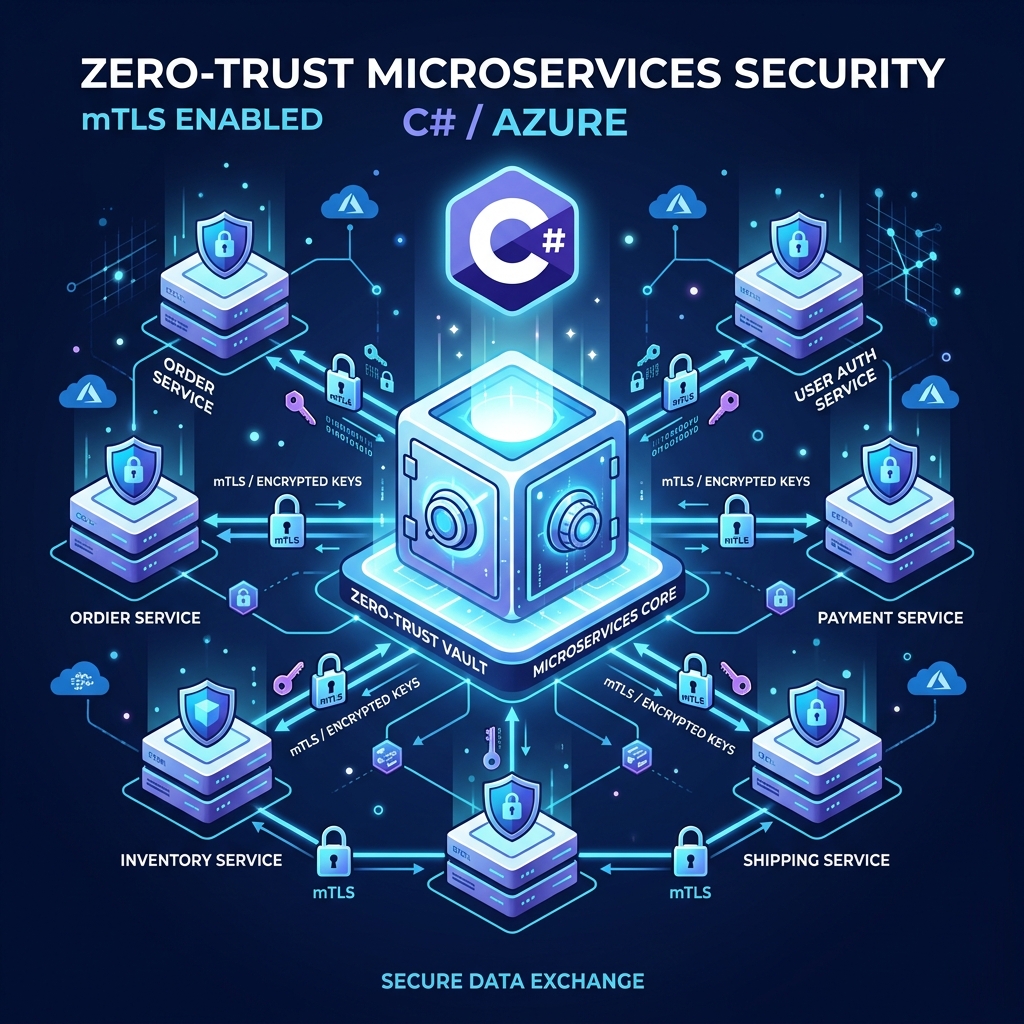
In modern software engineering, perimeter-based security is dead. Traditionally, companies focused solely on building a strong outer firewall around their corporate network, assuming that everything inside the network was safe. However, if an attacker compromises a single low-security internal server, they can easily move laterally across the entire network to access confidential databases.
To prevent these security breaches, enterprise architectures are adopting a Zero-Trust Security Model. Under Zero-Trust, the core principle is simple: *never trust, always verify*. Every single request—whether originating from outside the web firewall or from a sister service within your own cloud cluster—must be cryptographically authenticated, authorized, and audited at every single step.
What is Mutual TLS (mTLS)?
In standard HTTPS, only the server proves its identity using a certificate. In mutual TLS (mTLS), both the client and the server must verify each other's security certificates before establishing a connection. This guarantees that only authorized microservice nodes can communicate with your core database APIs.
1. The 3 Layers of Zero-Trust Defense
Implementing a Zero-Trust architecture in ASP.NET Core requires securing three nested defense boundaries: the network entrance, inter-service calls, and secret storage:
API Gateway Authorization (OAuth2 & JWT)
Every request entering the system must present a cryptographically signed JSON Web Token (JWT) issued by your Identity Provider. The API Gateway validates token signatures, expiration dates, and role-based scope claims before routing traffic to internal services.
Inter-Service Encryption (mTLS)
Internal calls between microservices (e.g. your Order Service calling the Payment API) cannot travel in plain text. Connections require mutual TLS encryption, verifying client certificates at the application layer to block intruder eavesdropping.
Secrets Vault Isolation (Azure Key Vault)
Database connection strings, API keys, and private certificates must never be hardcoded in application configuration files. The C# runtime fetches these keys dynamically from Azure Key Vault at startup using managed user identities.
2. Traditional Firewall vs. Zero-Trust Defense
Understanding the difference in security posture reveals how Zero-Trust protects your business during an active cyber attack:
Perimeter Defense Only
If a hacker breaches the web server, they gain immediate read/write access to all internal resources.
Continuous Verification
If one service is compromised, the hacker is trapped and cannot access sister APIs or database cores.
3. Enterprise Security Compliance Checklist
The table below lists the essential security rules mandated by SOC 2 and ISO 27001 audits and how they are handled in a .NET architecture:
| Compliance Category | Audit Requirement | .NET Implementation Strategy |
|---|---|---|
| Data in Transit Encryption | All network packets must be encrypted between all servers. | Enforce mTLS (mutual TLS 1.3) via Kestrel server configurations and secure gateway policies. |
| Access Control Audit Logs | Record every data access event with user ID and exact timestamp. | Database transaction interceptors logging user context and action details to immutable logs. |
| Secrets Rotation | API keys and database credentials must rotate every 90 days. | Azure Key Vault dynamic fetching combined with automated credential rotation scripts. |
| Minimum Privileges | Restrict user and service operations based on exact business roles. | Enforce strict Claims-Based and Scope-Based Authorization policies on all API route controllers. |
Architect's Tip: Implement Token Lifespan Limits
Never issue JSON Web Tokens (JWT) that are valid for more than 15-30 minutes. If a long-lived access token is compromised, a hacker has unlimited access. Implement short-lived access tokens combined with secure refresh tokens stored safely in HTTP-only, encrypted database tables.
Partner with Krista Technology for Secure Enterprise Software
Building Zero-Trust microservices, passing SOC 2 security compliance audits, and configuring distributed Azure architectures requires senior-level engineering oversight. At Krista Technology, we are a Microsoft Solutions Partner specialized in designing secure C# Web APIs, implementing mutual TLS pipelines, and orchestrating secure cloud databases under strict security protocols.
If you want to validate your current application security, prepare for a SOC 2/ISO audit, or hire a pre-vetted team of compliance-ready backend developers, contact our dedicated .NET Security Engineers today for a free technical consultation and security architecture review.