
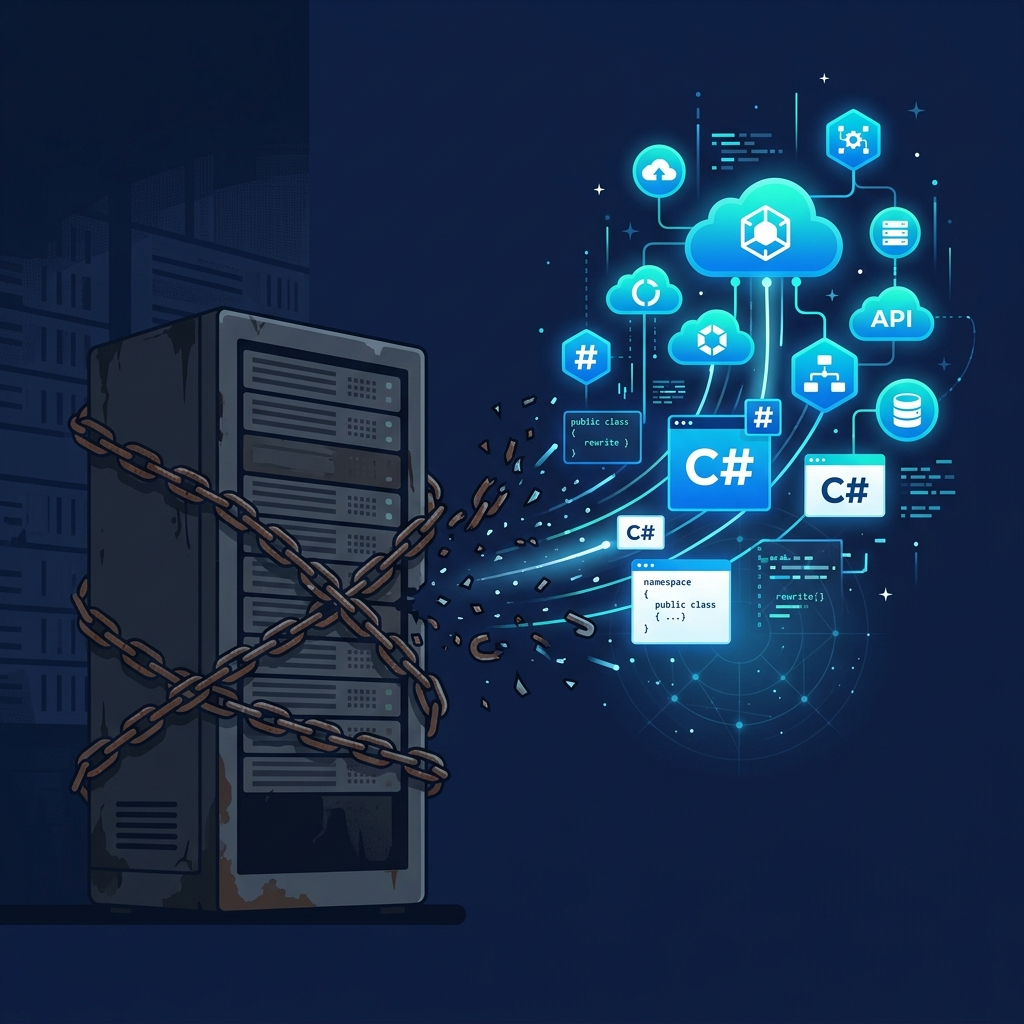
In the enterprise business landscape, software applications are the engines driving daily operations, logistics, and sales. However, as technologies evolve, once-innovative software systems eventually become outdated. Legacy software built on obsolete frameworks—such as ASP.NET WebForms, classic C# WCF services, or old .NET Framework platforms—eventually becomes slow, vulnerable to security exploits, and extremely expensive to maintain.
When maintenance costs begin draining your cloud budgets, software architects face a critical choice: Should we rewrite the entire application from scratch, or should we modernize it incrementally? By executing a structured Legacy System Modernization strategy using patterns like the Strangler Fig Pattern, you can safely migrate your legacy code into high-speed C# .NET Core microservices and Next.js frontends, guaranteeing zero data loss and uninterrupted operations.
What is the Strangler Fig Pattern?
Named after the natural vine that grows around an old tree, the Strangler Fig Pattern is a software migration strategy where you do not rewrite everything at once. Instead, you build modern C# microservices around the legacy application, routing new API requests to the new microservices while the old system continues to handle legacy tasks. Over time, the new system completely replaces the old one, allowing you to retire the legacy server safely.
1. The Modernization Risk-vs-Benefit Matrix
Understanding the comparison between keeping old systems alive versus executing an incremental cloud modernization roadmap:
The Cost of Doing Nothing
Legacy systems incur massive technical debt. You pay high licensing fees for outdated database servers, suffer from unpatched security vulnerabilities, and struggle to hire developers willing to work on old frameworks.
Incremental Modernization
Instead of a risky "big bang" rewrite, we isolate modular business services one by one. Using API gateways, we direct traffic to newly compiled C# microservices, minimizing code regression and ensuring business continuity.
Modern Cloud-Native State
The ultimate destination: serverless containers running on Azure, compiled .NET Core APIs rendering data in milliseconds, high-performance database indexing, and 100% automated CI/CD deployment pipelines.
2. The Strangler Fig Migration Roadmap
A production-grade software rewrite must follow a strict, phased execution timeline to prevent data corruption and downtime:
API Interception
Place an API Gateway (like Ocelot or Azure APIM) in front of the legacy monolith to control and distribute incoming client requests.
Service Extraction
Identify and extract key database modules (such as order billing) and rewrite them as isolated C# microservices.
Traffic Diversion
Update the API Gateway to route specific requests to the new services, while keeping legacy requests routed to the old backend.
Monolith Retirement
Once 100% of network traffic successfully routes to the modern microservice architecture, safely deprecate and shut down the old legacy monolith.
3. Technology Architecture Modernization Table
The comparison below highlights the operational advantages of moving from legacy Windows hosting environments to modern, scalable cloud structures:
| Operational Parameter | Legacy .NET Framework Monolith | Modern Cloud-Native .NET Core |
|---|---|---|
| Server Operating System | Windows Server IIS (High OS license fees). | Linux Server / Serverless Containers ($0 licensing) |
| Scaling Capabilities | Vertical Scaling (Requires manual server upgrades and causes downtime). | Horizontal Serverless Auto-scaling (scales in milliseconds) |
| API Response Latency | High (Due to synchronous thread blocks and unoptimized DB structures). | Ultra-Low (Asynchronous thread execution & gRPC support) |
| Hiring Speed (Developers) | Slow (Top-tier developers refuse to work on legacy code frameworks). | Fast (Abundant pool of modern React & C# engineers) |
CTO Tip: Perform a Security Penetration Audit Before Modernization
Legacy applications often contain unpatched security exploits (such as outdated library vulnerabilities or SQL injection risks) that have gone unnoticed for years. Before you begin writing a single line of new code, perform a comprehensive security audit of your database schemas and APIs. This ensures that you do not accidentally copy legacy security vulnerabilities into your brand-new microservices.
Partner with Krista Technology to Modernize Your Platforms
Rewriting legacy systems, mapping database migrations, establishing API routing gateways, and deploying serverless containers requires senior-level software architects. At Krista Technology, we are a Microsoft Solutions Partner specializing in legacy system modernization, database refactoring, and high-performance cloud application migrations globally.
If you want to migrate your old legacy software, modernize your database schemas, or hire a team of dedicated software architects, contact our dedicated .NET Migration Engineers today for a free technical consultation and modernization estimate.