
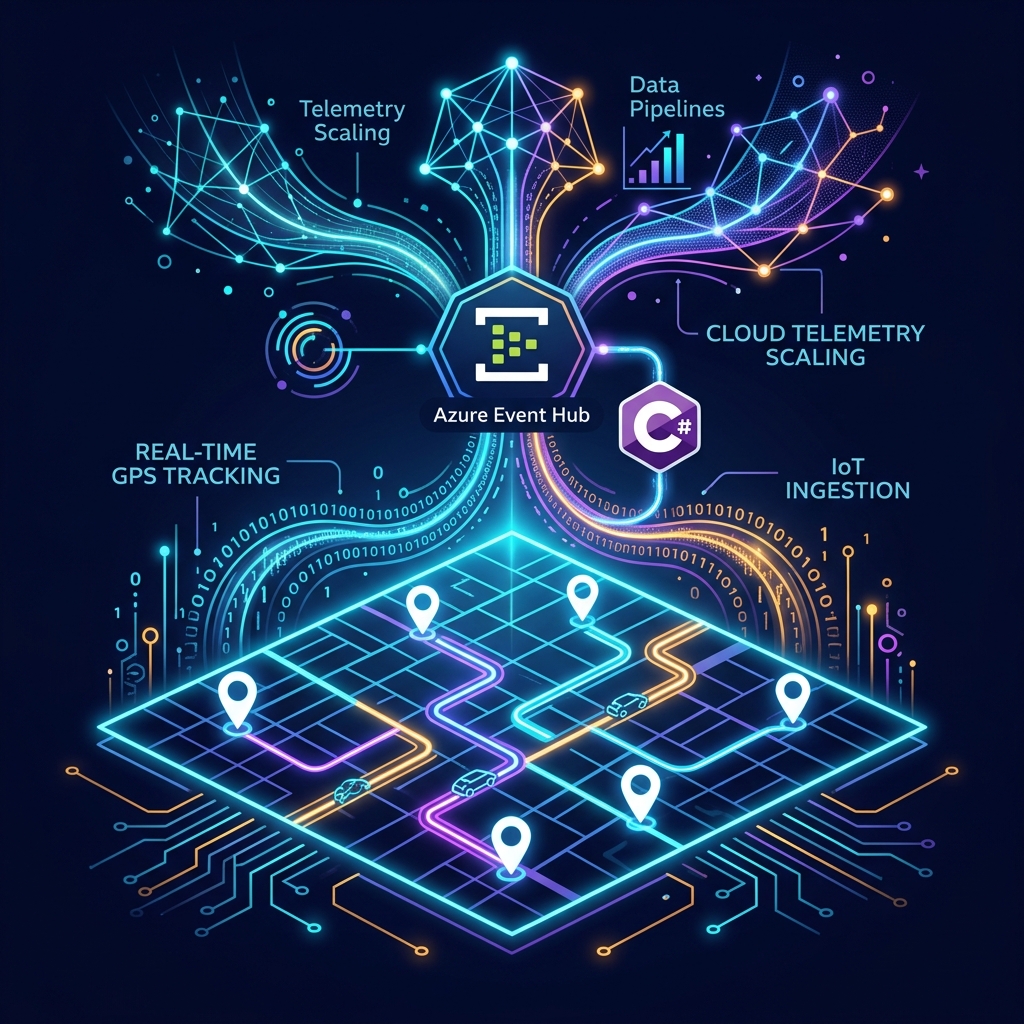
For modern logistics, supply chain, and fleet operators, real-time visibility is no longer a luxury—it is an operational necessity. GPS tracking platforms must ingest, process, and display location data from thousands of active devices simultaneously. When a fleet grows from 100 to 10,000+ vehicles, a standard relational database and HTTP API architecture will quickly collapse under the weight of high-frequency telemetry write requests.
Each vehicle sends a ping every 2–5 seconds containing coordinates, speed, fuel status, engine diagnostics, and driver alerts. This generates tens of thousands of requests per second. To build a system that scales seamlessly, developers must shift from traditional REST APIs to an event-driven, connection-oriented ingestion pipeline using ASP.NET Core WebSockets and Azure Event Hubs.
The Telemetry Scaling Challenge
With 10,000 active GPS units sending telemetry every 3 seconds, a platform must handle over 200,000 writes per minute. Performing a synchronous HTTP POST and direct SQL database write for every single ping will result in connection pool exhaustion, database locking, and eventual server failure. High-throughput ingestion requires decoupling connection management from database storage.
The Real-Time Ingestion Architecture
A production-grade, high-throughput GPS ingestion architecture segregates concerns into three core layers: connection hold, queue buffer, and asynchronous persistence.
1. Connection Layer
Persistent ASP.NET Core WebSockets maintain open duplex connections. GPS devices stream data continuously, eliminating HTTP request overhead.
2. Buffering Layer
Telemetry is buffered into Azure Event Hubs. This event bus absorbs high-frequency spikes and acts as a shock absorber.
3. Persistence Layer
Background worker services process Event Hub streams in batches, executing bulk database writes (PostgreSQL/TimescaleDB) asynchronously.
Implementing WebSocket Ingestion in C#
Using ASP.NET Core, we can establish persistent WebSocket connections and stream coordinates into high-speed memory queues (using System.Threading.Channels) for asynchronous background processing:
using System.Net.WebSockets; using System.Threading.Channels; using Microsoft.AspNetCore.Mvc; public class GpsIngestionController : ControllerBase { private readonly Channel<GpsTelemetry> _telemetryChannel; public GpsIngestionController(Channel<GpsTelemetry> telemetryChannel) { _telemetryChannel = telemetryChannel; } [HttpGet("/ws/telemetry")] public async Task GetWebSocketConnectionAsync() { if (HttpContext.WebSockets.IsWebSocketRequest) { using var webSocket = await HttpContext.WebSockets.AcceptWebSocketAsync(); await ProcessConnectionStreamAsync(webSocket); } else { HttpContext.Response.StatusCode = StatusCodes.Status400BadRequest; } } private async Task ProcessConnectionStreamAsync(WebSocket webSocket) { var buffer = new byte[1024 * 4]; var result = await webSocket.ReceiveAsync(new ArraySegment<byte>(buffer), CancellationToken.None); while (!result.CloseStatus.HasValue) { var rawData = Encoding.UTF8.GetString(buffer, 0, result.Count); var telemetry = JsonSerializer.Deserialize<GpsTelemetry>(rawData); if (telemetry != null) { await _telemetryChannel.Writer.WriteAsync(telemetry); } result = await webSocket.ReceiveAsync(new ArraySegment<byte>(buffer), CancellationToken.None); } await webSocket.CloseAsync(result.CloseStatus.Value, result.CloseStatusDescription, CancellationToken.None); } }Batch Persistence: TimescaleDB and Spatial Indexing
Once events are buffered into Azure Event Hubs, background workers consume them in batches of 500–1,000 records. For GPS coordinate storage, standard relational databases suffer from index fragmentation. To resolve this, enterprise architectures utilize PostgreSQL with the TimescaleDB extension (for time-series chunking) and PostGIS (for spatial coordinates):
- Time-Series Partitioning: TimescaleDB automatically chunks tables by time (e.g. daily database partitions), ensuring recent writes always write to active memory instead of searching a massive, fragmented index.
- Spatial GIST Indexing: Storing coordinates as a geometry/geography data type with a GiST spatial index allows sub-millisecond geofencing queries and instant coordinate lookups on mapping dashboards.
Architect's Tip: Use Azure Event Hubs Partitions
When deploying Azure Event Hubs, set the Partition Key to the VehicleId or DeviceId. This guarantees that all telemetry packets from the same vehicle are processed in strict chronological order on the same partition, preventing race conditions or out-of-order coordinate logging.
Why Krista Technology is the Premier Choice for IoT Solutions
Building real-time tracking systems, telemetry ingestion layers, and high-performance logistics ERP platforms requires advanced cloud architecture expertise. At Krista Technology, we design high-throughput systems utilizing Microsoft .NET 9, WebSockets, timeseries databases, and Azure event infrastructures to handle millions of GPS telemetry signals daily.
If you want to build custom GPS tracking software, scale up your IoT pipeline, or hire an expert team of dedicated developers, contact our dedicated .NET IoT Engineers today to review your architecture and request a prototype demonstration.