In the current business landscape, integrating Generative AI features like automated customer support, document analysis, or report generation is a massive competitive advantage. However, many software founders and enterprises face a harsh financial reality after launch: skyrocketing OpenAI API bills. As traffic grows, paying per token for every query quickly becomes unsustainable, eating into software profit margins.
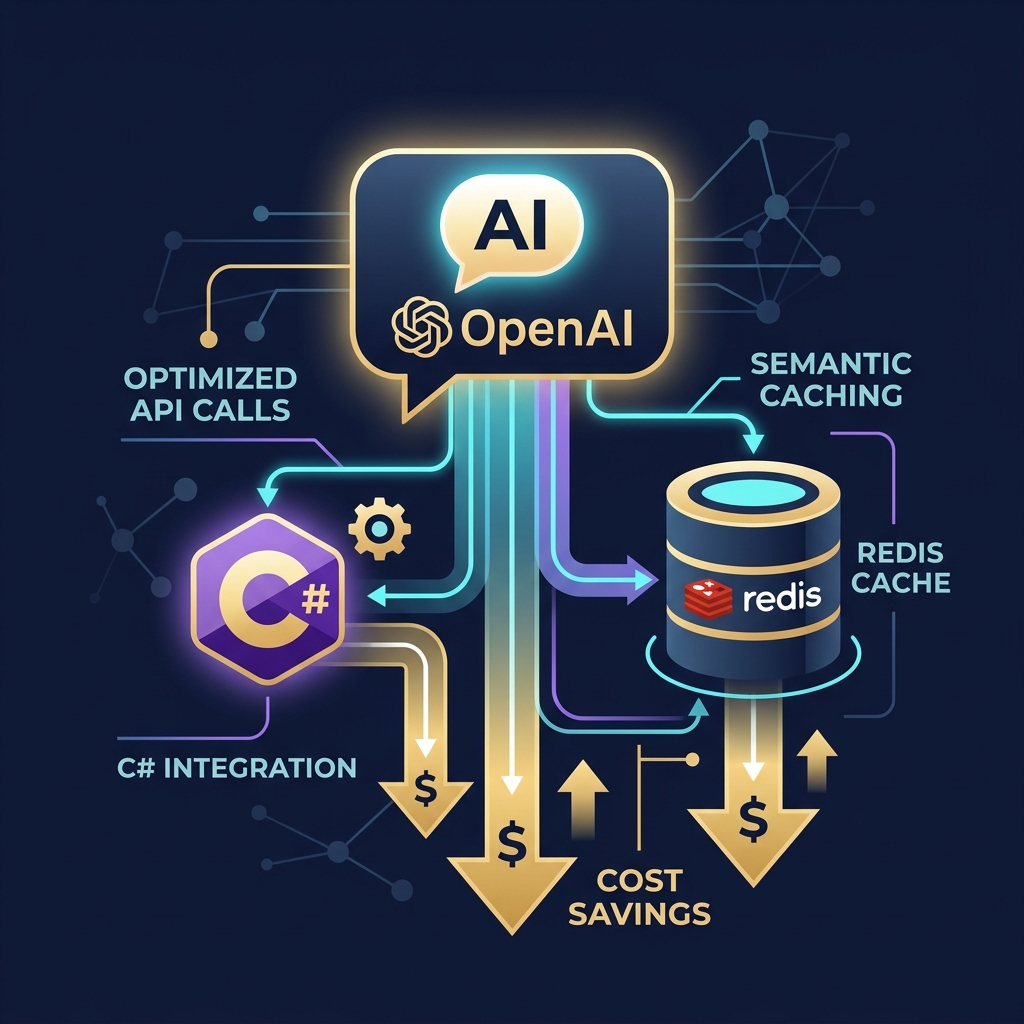
While Large Language Models (LLMs) like GPT-4 are incredibly capable, calling them repeatedly for similar user questions is a waste of computing resources. By implementing Semantic Caching using C# and Redis, your application can intercept incoming user queries, recognize semantically identical questions, and serve cached responses instantly. This strategy, combined with prompt token pruning, can easily slash your monthly AI operation costs by over 70%.
What is Semantic Caching?
Traditional caching requires an exact, character-for-character string match to return a result. Semantic caching is much smarter: it uses vector embeddings to calculate the mathematical similarity between queries. If a user asks "How do I reset my password?" and another asks "Can you tell me how to change my password?", the system recognizes the identical meaning and serves the cached answer instantly, bypassing the LLM completely.
1. AI Operational Cost: Before vs. After Optimization
Deploying raw prompts without optimization results in exponential cost curves. Below is a budget comparison of a SaaS platform handling 100,000 monthly user queries:
Direct LLM Calls Only
Every user query is sent to OpenAI, creating massive duplicate billing charges.
Semantic Caching Enabled
Redis caches 60% of common customer questions, reducing API load and token count.
2. The Semantic Caching Decision Pipeline
To protect your API budget, your C# middleware must process queries through a validation check before sending any data to OpenAI. Below is the decision tree workflow:
Query Conversion
The C# system converts the incoming user query into vector embeddings using a fast, low-cost embedding model.
Similarity Query
Queries the Redis database to check if any previously saved query has a cosine similarity score higher than 0.95.
Cache Hit: Serve Free
If a matching query is found, the system retrieves the answer instantly from Redis cache. Cost: $0.00, Latency: <15ms.
Cache Miss: Run LLM
If no match is found, the query calls the OpenAI API, and the new response is saved into Redis for future users.
3. Strategic Token Reduction Checklist
Beyond caching, optimizing the structure of your prompts is the most effective way to reduce billing costs. Every single word in your prompt template costs money:
| Token Saving Strategy | How it works | Estimated Cost Reduction |
|---|---|---|
| System Message Trimming | Rewrite instructions to be concise. Avoid wordy prompt templates. | 15% - 20% Saved |
| Dynamic Chat History Pruning | Do not send the entire conversation log. Summarize old turns and send only the last 3-5 exchanges. | 30% - 40% Saved |
| Hybrid Open-Source Routing | Route simple sorting, parsing, or formatting tasks to low-cost local models (like Llama 3) instead of GPT-4. | 50% Saved |
| Output Token Constraints | Instruct the LLM to write brief, point-by-point answers instead of long paragraphs. | 10% - 15% Saved |
Architect's Tip: Use GPT-4o-Mini for Routing Checks
Instead of sending all requests to the expensive GPT-4o engine, implement a "Router Model" using GPT-4o-Mini or Llama 3. The cheap router model analyzes the query complexity, answering basic questions itself and forwarding only high-difficulty reasoning requests to GPT-4o.
Partner with Krista Technology to Optimize Your AI Infrastructure
Integrating artificial intelligence features, setting up high-performance semantic caches, and optimizing cloud API routing require senior-level backend expertise. At Krista Technology, we are a Microsoft Solutions Partner helping startups and enterprises design token-efficient AI architectures, deploy local vector databases, and scale custom .NET systems under strict cloud budget controls.
If your platform is experiencing high OpenAI billing, slow response times, or if you want to integrate a cost-efficient AI agent into your software, contact our dedicated .NET AI Solutions Engineers today for a free technical consultation and prompt optimization audit.