
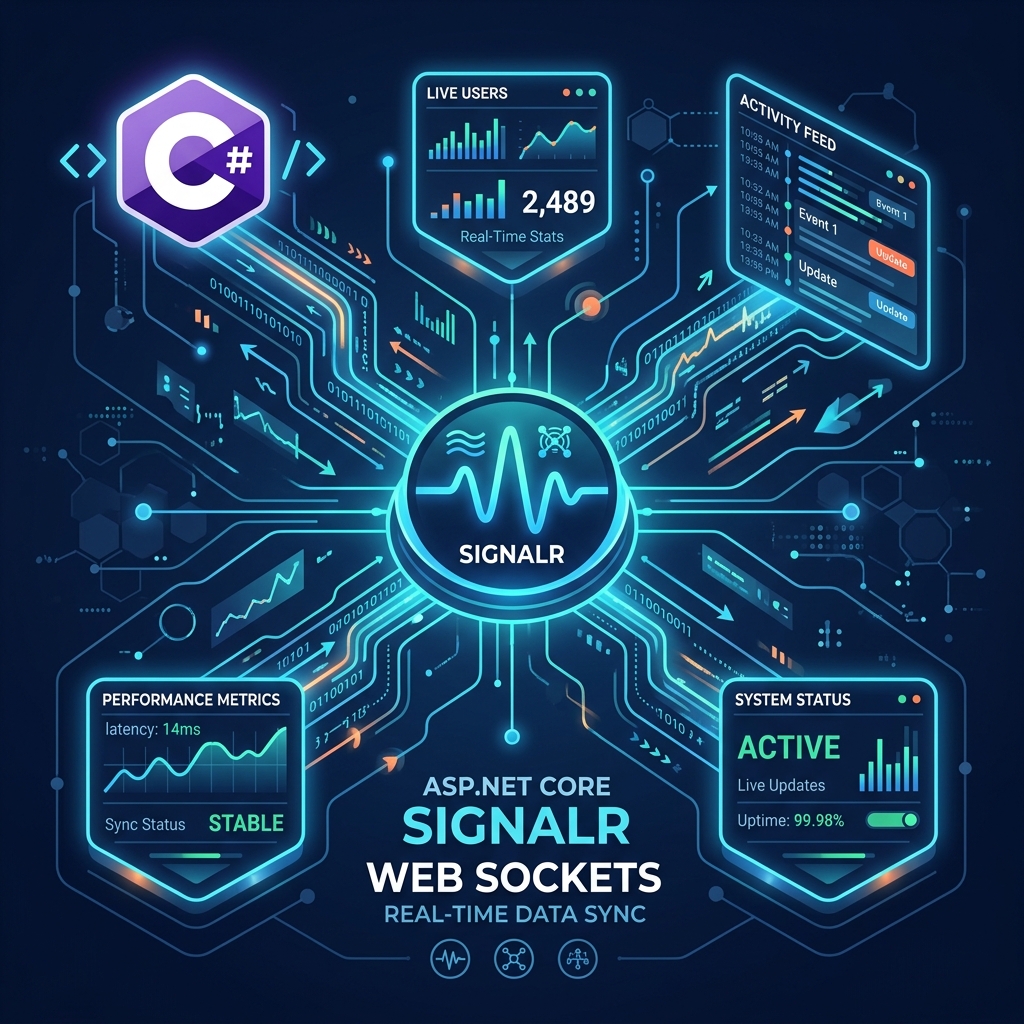
In today's fast-paced digital economy, users no longer tolerate page refreshes or manual updates. Whether it is a real-time GPS fleet tracking dashboard, a financial trading desk, an interactive SaaS collaboration canvas, or an instant chat system, modern software applications must push data from the server to thousands of connected client screens in sub-50 milliseconds.
Building real-time bi-directional communication requires moving beyond traditional HTTP request-response cycles. Using ASP.NET Core SignalR, software engineering teams can construct high-throughput WebSocket pipelines. SignalR abstracts the complexities of managing persistent socket connections, automatically negotiating protocols, handling network drops, and broadcasting live events across distributed server clusters.
What is Full-Duplex Communication?
Traditional HTTP is "half-duplex"—the client must explicitly send a request before the server can reply. WebSockets provide "full-duplex" communication, creating a persistent, open TCP channel where both client and server can send data packets simultaneously at any millisecond without header overhead.
1. Real-Time Protocol Speedometer Matrix
Choosing the right protocol determines server overhead and data latency. The comparison below illustrates why SignalR with WebSockets is the premier choice for modern applications:
HTTP Short Polling
The client sends repeated HTTP requests every 2-5 seconds asking "Is there new data?". Generates massive database load and network header waste.
Server-Sent Events (SSE)
The server keeps a single HTTP connection open to push updates to the browser. Useful for live feeds, but cannot receive data back from clients over the same channel.
SignalR + WebSockets
Persistent full-duplex TCP channels with zero HTTP header overhead per frame. Instant bidirectional streaming for real-time dashboards and telemetry.
2. SignalR Automatic Transport Fallback Hierarchy
Client devices operate across diverse network environments, corporate firewalls, and proxy servers. ASP.NET Core SignalR guarantees connectivity by implementing a three-tier automatic fallback negotiation system:
WebSockets Protocol
Established over standard port 443 (WSS). Provides native binary frame streaming with sub-30ms latency.
Server-Sent Events (SSE)
Automatically triggered if corporate firewalls block raw WebSocket TCP handshake upgrades.
Long Polling
Emergency fallback for legacy browsers. Keeps an HTTP request open until data is available, then immediately reconnects.
3. Scaling SignalR with Redis Backplane Clusters
When your web application scales horizontally across multiple cloud servers (e.g. Server A, Server B, and Server C in an Azure Scale Set), Client 1 connected to Server A cannot directly hear messages sent by Client 2 connected to Server B. To resolve this, software architects deploy a Redis Pub/Sub Backplane:
How Redis Backplane Coordinates 100,000+ Connections
When a client triggers a real-time event on Server A, SignalR serializes the payload and publishes it to a shared Redis Pub/Sub channel. Redis instantly broadcasts the message to Server B and Server C within 2 milliseconds, allowing all servers to push the update to their connected WebSocket clients simultaneously.
4. Real-Time Technology Selection Checklist
The table below outlines common real-time business use cases and the recommended ASP.NET Core SignalR architecture:
| Application Use Case | Recommended Protocol | C# Scaling Architecture |
|---|---|---|
| GPS Fleet & Vehicle Telemetry Tracking | WebSockets (Binary MessagePack Format) | SignalR + Azure SignalR Service with Redis Backplane. |
| Financial Stock & Crypto Trading Desk | WebSockets (Streaming Channel Methods) | Direct TCP MemoryStreams with zero-allocation buffers. |
| Live Customer Support & In-App Chat | SignalR Hubs (JSON Text Protocol) | Group-based room authorization with Azure SQL logging. |
| Collaborative SaaS Document Canvas | WebSockets (State Difference Delta Sync) | Operational Transformation (OT) handlers in C#. |
Architect's Tip: Use MessagePack Serialization for 60% Faster Payload Transfer
By default, SignalR sends messages in JSON text format. For high-concurrency systems streaming GPS coordinates or financial charts, configure SignalR to use MessagePack binary protocol. MessagePack compacts data frames by up to 60%, reducing network bandwidth and CPU serialization overhead dramatically.
Partner with Krista Technology for Real-Time Software Solutions
Building sub-50ms real-time applications, configuring Redis backplane clusters, and optimizing WebSocket pipelines requires senior backend engineering expertise. At Krista Technology, we are a Microsoft Solutions Partner with extensive experience constructing custom GPS telemetry engines, live fleet tracking portals, and enterprise SaaS dashboards using ASP.NET Core SignalR and Azure Cloud Services.
If you want to build a real-time portal, optimize an existing dashboard, or hire a team of senior C# backend developers, contact our dedicated SignalR & Real-Time Engineers today for a technical consultation and architecture estimate.