
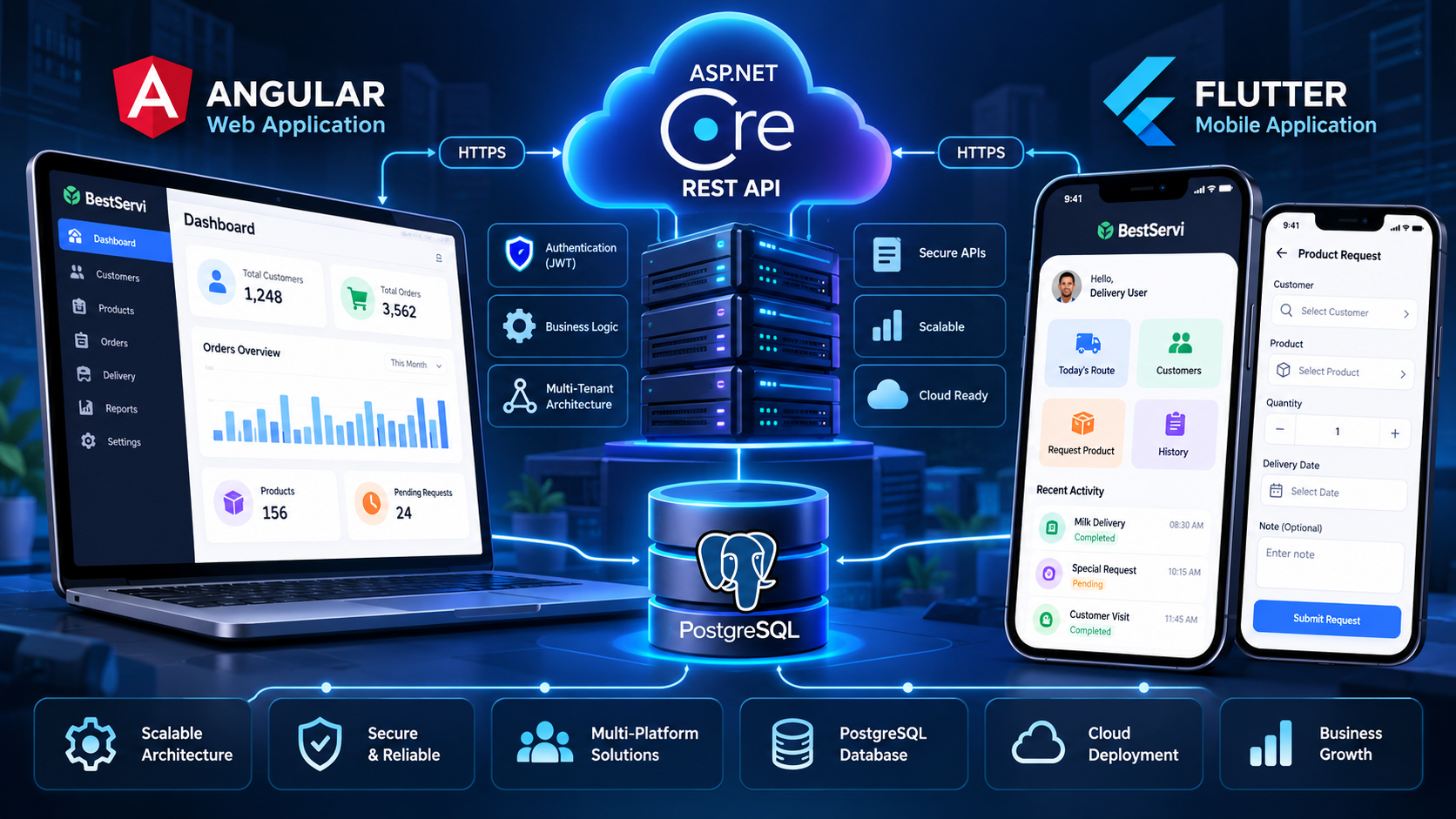
Building Scalable Enterprise Applications
A modern architecture blueprint using ASP.NET Core, Angular, Flutter, and PostgreSQL for secure, scalable, and maintainable business applications.
Introduction: Engineering for Business Growth
Modern enterprises need more than functional software. They need secure, scalable, maintainable digital platforms that can support increasing user activity, complex business processes, and consistent experiences across web and mobile applications.
For CTOs, startup founders, and business owners, choosing the right technology architecture is essential for long-term success. ASP.NET Core, Angular, Flutter, and PostgreSQL offer a cohesive technology foundation for building enterprise applications in 2026.
1. The Three Pillars of Enterprise Architecture
A well-designed enterprise application must balance three fundamental requirements: security, scalability, and maintainability.
Security by Design
Protect sensitive business data using secure authentication, server-side authorization, HTTPS communication, input validation, and tenant-level data isolation.
Scalable Performance
Support growing workloads through optimized database queries, caching, asynchronous processing, monitoring, and appropriate infrastructure scaling.
Maintainable Systems
Use modular architecture, reusable components, dependency injection, automated testing, and clear separation of business responsibilities.
2. Modern Enterprise Technology Stack
Each technology has a specific responsibility in the overall application architecture. Together, they provide a consistent foundation for web, mobile, backend, and database operations.
ASP.NET Core
REST APIs, business logic, authentication, authorization, validation, and integration services.
Angular
Administrative dashboards, reporting, complex forms, reusable UI components, and business workflows.
Flutter
Cross-platform Android and iOS applications, customer workflows, delivery operations, and mobile API integration.
PostgreSQL
Relational data management, transactions, indexing, integrity constraints, and reliable business data storage.
3. Enterprise API Request Lifecycle
A shared ASP.NET Core backend allows Angular and Flutter applications to execute business operations through a consistent, secure API architecture.
Client Request
Angular or Flutter sends an HTTPS request containing the required business data and credentials.
API Validation
ASP.NET Core validates authentication, permissions, tenant context, and incoming request data.
Business Logic
Application services enforce business rules and perform authorized database operations.
Client Response
The API returns a structured response and the application updates the relevant user interface.
4. ASP.NET Core: Building the Enterprise Backend
ASP.NET Core is Microsoft's cross-platform framework for developing modern APIs and enterprise business applications. Its dependency injection, asynchronous programming model, authentication support, and flexible deployment options make it suitable for complex business systems.
API Layer → Application Layer → Domain Layer → Infrastructure Layer
The API layer handles HTTP requests and responses. The application layer coordinates use cases, the domain layer contains business rules, and the infrastructure layer implements database and external service integration.
This separation improves testability, maintainability, and the ability to evolve individual parts of the system.
5. Angular and Flutter: Enterprise User Experiences
Angular and Flutter provide complementary interfaces for different business requirements. Angular is especially useful for structured administrative workflows, while Flutter supports mobile experiences for customers and field personnel.
| BUSINESS PARAMETER | ANGULAR WEB | FLUTTER MOBILE |
|---|---|---|
| Primary Use | Administrative dashboards and business portals | Customer and field operation applications |
| Language | TypeScript | Dart |
| UI Architecture | Component-based | Widget-based |
| API Integration | HTTP client services | HTTP networking libraries |
| Typical Users | Administrators, managers, business operators | Customers, drivers, field personnel |
6. PostgreSQL: Reliable Enterprise Data Management
PostgreSQL provides transactional consistency, relational integrity, advanced indexing, and support for complex business queries. It is a strong database option for applications managing customers, products, orders, delivery assignments, inventory, and financial records.
Use database transactions and constraints to protect consistency across related business operations.
Improve performance through suitable indexing, pagination, query analysis, and connection pooling.
Enforce tenant-aware authorization and data access rules to prevent unauthorized information exposure.
7. Enterprise Security Architecture
Security should be incorporated throughout the application lifecycle. Backend authorization, data validation, secure configuration, and monitoring are essential for protecting enterprise systems.
Authentication
Validate user identity through appropriate authentication mechanisms and securely managed access tokens.
Authorization
Apply least-privilege policies and verify role permissions and tenant context for sensitive operations.
Data Protection
Use HTTPS, input validation, secure secret management, and appropriate database protection measures.
8. Performance and Scalability Strategies
Applications should maintain predictable performance as user activity and data volumes increase. Scalability requires identifying actual bottlenecks rather than adding unnecessary infrastructure complexity.
| STRATEGY | IMPLEMENTATION | BUSINESS BENEFIT |
|---|---|---|
| Database Indexing | Index frequently filtered and joined columns | Faster query execution |
| Caching | Cache suitable frequently accessed data | Reduced backend workload |
| Async Processing | Use asynchronous I/O and background jobs | Improved responsiveness |
| Pagination | Load records in manageable batches | Lower transfer and rendering costs |
| Monitoring | Collect logs, metrics, and traces | Faster issue identification |
9. Deployment and DevOps Lifecycle
Production readiness depends on repeatable deployment procedures, testing, secure configuration, backups, monitoring, and recovery planning.
Build
Compile backend, web, and mobile applications with environment-specific configuration.
Test
Run unit, integration, security, and regression tests before releasing changes.
Deploy
Release through controlled pipelines with migration, backup, and rollback procedures.
Monitor
Observe production performance, application errors, security events, and infrastructure health.
10. Building for Long-Term Business Growth
The best architecture is not necessarily the most complicated. Technology decisions should be guided by business requirements, security expectations, expected growth, development expertise, integration needs, and operational costs.
A well-structured modular monolith is often an effective starting point. Microservices, distributed caching, and more complex infrastructure can be introduced when measured requirements justify them.
Build for today's requirements while keeping clear boundaries that allow tomorrow's growth. Prioritize measurable performance, security, maintainability, and business value.
Conclusion
Building scalable enterprise applications in 2026 requires thoughtful architecture, secure API design, reliable database management, and disciplined deployment practices.
ASP.NET Core provides a capable backend foundation, Angular enables structured enterprise web experiences, Flutter supports cross-platform mobile development, and PostgreSQL delivers dependable relational data storage.
When combined with sound engineering practices, these technologies can support modern SaaS platforms, logistics systems, customer portals, and enterprise business applications.
Planning a Custom Enterprise Application?
Work with an experienced software engineering team to design secure, scalable, and maintainable solutions aligned with your business goals.