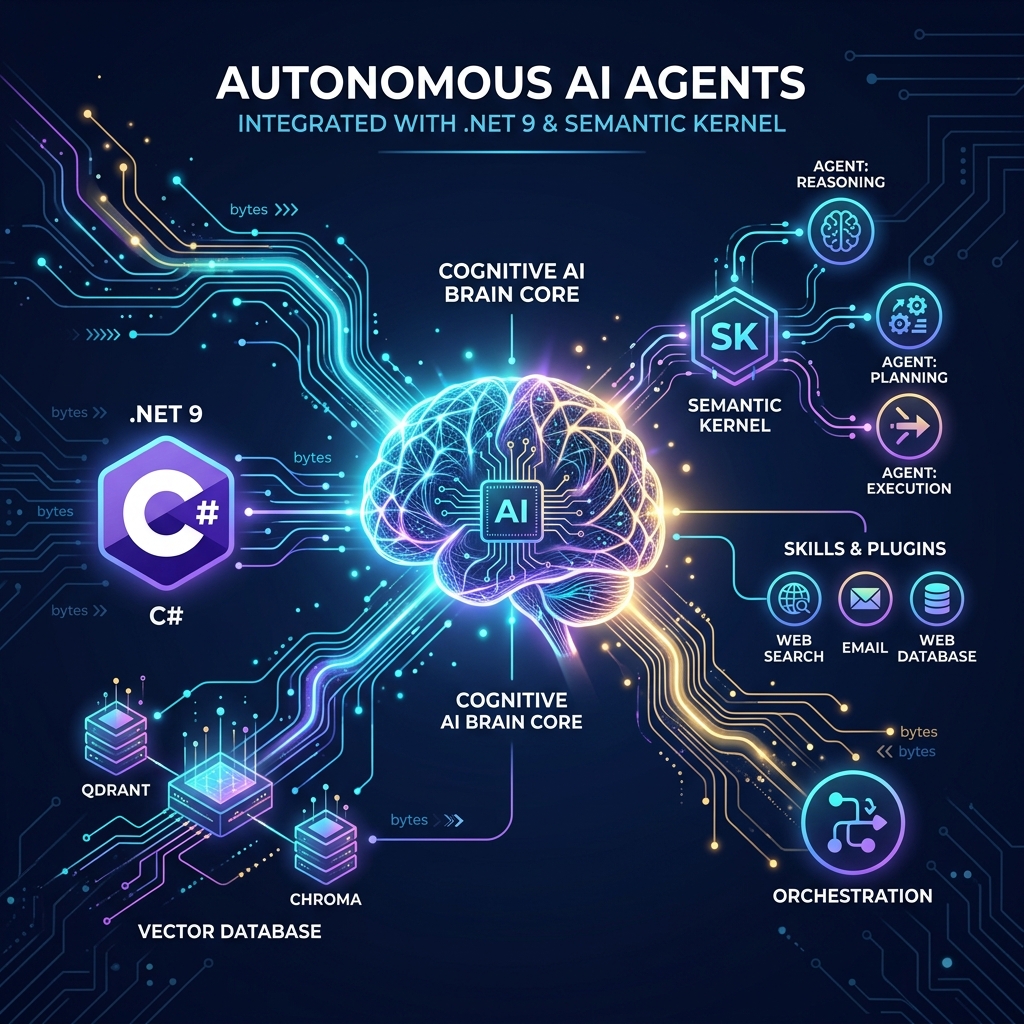
For modern enterprise software platforms, artificial intelligence has evolved far beyond basic text chatbots. Today’s business leaders are deploying Autonomous AI Agents—cognitive software systems capable of reasoning through multi-step goals, retrieving contextual company data, invoking C# backend services, and executing complex workflows without human intervention.
Building enterprise-grade AI agents requires a secure, high-performance orchestration framework. Operating within .NET 9, Microsoft’s Semantic Kernel SDK provides the ultimate bridge between Large Language Models (LLMs) and C# enterprise systems. By combining Semantic Kernel with high-density Vector Databases (such as Azure AI Search, pgvector, or Qdrant), software teams can construct private, context-aware AI agents that adhere strictly to corporate security governance.
What is an Autonomous AI Agent?
Unlike passive prompts that simply answer questions, an Autonomous AI Agent possesses memory, planning capabilities, and tool-calling skills. When given a business goal (e.g. "Reconcile unpaid invoices for Q2"), the agent creates a sequence of sub-tasks, queries your database for relevant customer records, calls accounting APIs, and compiles a verified audit report automatically.
1. Cognitive AI Agent Execution Pipeline
To safely grant AI models the authority to execute business operations, your C# backend must channel user requests through a multi-stage cognitive pipeline. Below is the workflow architecture:
Intent & Goal Decomposition
The AI Agent parses complex user prompts into discrete, structured action plans using Semantic Kernel planners.
Vector Memory Retrieval
Queries PostgreSQL/pgvector to fetch contextual company documents via Retrieval-Augmented Generation (RAG).
Native C# Plugin Invocation
The LLM dynamically selects and executes native C# methods to fetch database records or trigger external webhooks.
Verification & Response
Validates output against enterprise compliance policies and formats response for the end-user.
2. Enterprise AI Architecture Comparison Matrix
Choosing the right AI architectural pattern determines the scalability and data safety of your software. The table below compares traditional AI approaches with autonomous agent systems:
| AI System Architecture | Data Access Capability | Action Execution Scope | Enterprise Suitability |
|---|---|---|---|
| Simple LLM Prompting | Public training data only. No internal DB access. | Passive text generation only. Zero API execution. | Low (Public Use Only) |
| Standard Vector RAG | Retrieves internal PDFs and SQL records via embeddings. | Provides context-rich answers, but cannot trigger API changes. | Moderate (Q&A Portals) |
| Autonomous .NET 9 Agent | Real-time Hybrid Vector + SQL Relational Memory. | Executes C# functions, updates DBs, and invokes external webhooks. | High (Enterprise Automation) |
Data Privacy & Local Vector Database Security
When building AI agents for enterprise clients, sensitive business data must never be used to train public LLM models. By deploying self-hosted vector databases (like pgvector inside Azure PostgreSQL) and connecting via Azure OpenAI private endpoints, your data remains completely enclosed within your tenant boundary.
3. Key Pillars of a Production AI Agent System
Building AI agents that operate safely in production requires establishing three core software engineering pillars:
- Deterministic Function Filters: Do not allow LLMs to run destructive operations (like deleting database rows) without strict validation layers. Use C# filter attributes to inspect parameters before execution.
- Hybrid Search (Dense + Sparse): Combine vector semantic search with traditional full-text SQL search. This ensures that exact keyword matches (like part numbers or invoice IDs) are never missed by vector embeddings.
- Context Truncation & Token Budgeting: LLMs have token limits. Your .NET middleware must automatically summarize chat histories and prune irrelevant memory chunks to keep API costs low and response speeds fast.
Architect's Tip: Use Microsoft Semantic Kernel in .NET 9
Avoid building custom HTTP wrappers around OpenAI APIs. Semantic Kernel provides native C# dependency injection, automatic OpenAPI plugin parsing, telemetry logging, and streaming responses out of the box, drastically reducing development time.
Partner with Krista Technology to Build Enterprise AI Solutions
Building autonomous AI agents, fine-tuning RAG pipelines, and integrating vector databases into legacy C# architectures requires specialized AI engineering skills. At Krista Technology, we are a Microsoft Solutions Partner helping businesses leverage .NET 9, Azure OpenAI, and custom AI agents to automate workflows and unlock proprietary data value.
If you want to build a custom AI agent, integrate intelligent search into your software, or hire a team of dedicated C# AI developers, contact our dedicated .NET AI Solutions Engineers today for a technical consultation and proof-of-concept architecture review.