
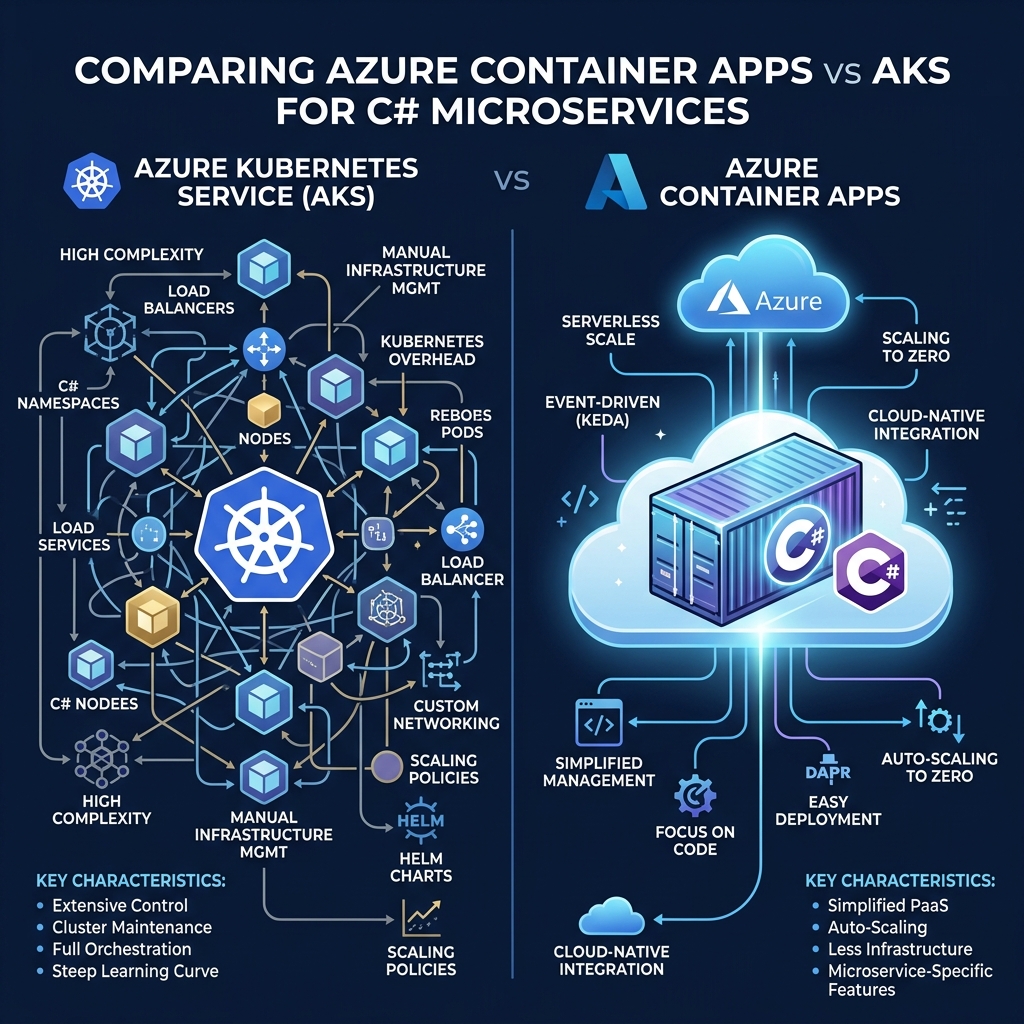
When organizations transition their monolithic enterprise applications into modern C# microservices, software architects face a critical cloud deployment decision: Where should we host our containerized applications? For years, the default industry answer was Kubernetes. However, setting up and maintaining a production-grade Kubernetes cluster is a notoriously complex DevOps challenge.
Operating Kubernetes requires managing VM node pools, ingress controllers, certificate managers, service meshes, and hundreds of lines of configuration files. For 90% of mid-sized businesses and software platforms, this operational overhead is an expensive waste of resource. By choosing Azure Container Apps (ACA)—Microsoft's serverless container scaling platform built on top of Kubernetes APIs—you can run high-density C# microservices with zero cluster management, enjoying automatic scale-to-zero configurations at a fraction of the cost.
What is Serverless Container Scale?
Traditional virtual machine containers run 24/7, meaning you pay for server resources even at 3:00 AM when there are zero customers. Serverless container scale allows your application instances to automatically scale down to exactly zero replicas during periods of inactivity. The moment a new user request hits your site, Azure Container Apps spins up a container in milliseconds to handle the request, ensuring you pay only for active compute seconds.
1. Infrastructure Complexity Comparison Dashboard
Evaluating the operational burden of each cloud solution reveals why serverless scaling delivers higher startup velocity:
Dedicated Cluster Model
Your engineering team must manually manage network routing, OS security updates, and container cluster configuration.
Serverless Microservices
Deploy raw container packages directly. Ingress, SSL certs, and auto-scaling are managed instantly in the background.
2. Serverless Auto-Scaling Lifecycle
The transition of user traffic from quiet periods to sudden high-concurrency requests follows an automated scale workflow:
Zero State Inactivity
During low-traffic hours, the container scale counts drop to exactly zero. Server resource billing stops completely.
First User Ingress
A customer visits the website. The HTTP gateway catches the request and triggers a container spin-up event.
Instant Scale-Up
Within milliseconds, a .NET microservice instance is launched to serve the active user request with zero delay.
Concurrency Scaling
If 10,000 users visit simultaneously, the system scales up to 30+ replicas, automatically load balancing the traffic.
3. Microservices Architecture Evaluation Table
The comparison below summarizes key operational decisions when evaluating Kubernetes versus serverless container environments:
| Evaluation Parameter | Azure Kubernetes Service (AKS) | Azure Container Apps (ACA) |
|---|---|---|
| Operational Complexity | High (Requires cluster configuration, YAML manifest management, and ingress rules). | Ultra-Low (Deploy container directly) |
| Microservices Integration | Requires manual setup of sidecars and service meshes. | Native Dapr sidecar integration enabled |
| HTTPS & Ingress Setup | Requires manual Nginx ingress config and Let's Encrypt certificates. | Built-in HTTPS and automatic SSL certificates |
| Billing Framework | Pay for VM nodes 24/7 (regardless of user traffic). | Pay only for CPU/Memory execution seconds |
Architect's Tip: Use Azure Container Apps for 90% of Startups
Do not default to Kubernetes just because giant tech companies like Netflix or Spotify use it. Kubernetes is built to manage massive networks of thousands of microservices. If your startup is launching a SaaS platform, a mobile backend, or a standard API portal, Azure Container Apps gives you the power of Kubernetes without the configuration nightmares.
Partner with Krista Technology to Deploy Scalable Cloud Systems
Building serverless container pipelines, optimizing Azure hosting architectures, and designing scalable C# microservices requires senior-level cloud DevOps engineering skills. At Krista Technology, we are a Microsoft Solutions Partner helping businesses migrate legacy on-premise servers to modern serverless containers, configure microservice scaling, and manage cloud budgets efficiently.
If you want to migrate your platform to serverless containers, optimize your Azure cloud bills, or hire a team of dedicated DevOps developers, contact our dedicated Azure Cloud Engineers today for a technical consultation and proof-of-concept architecture review.