
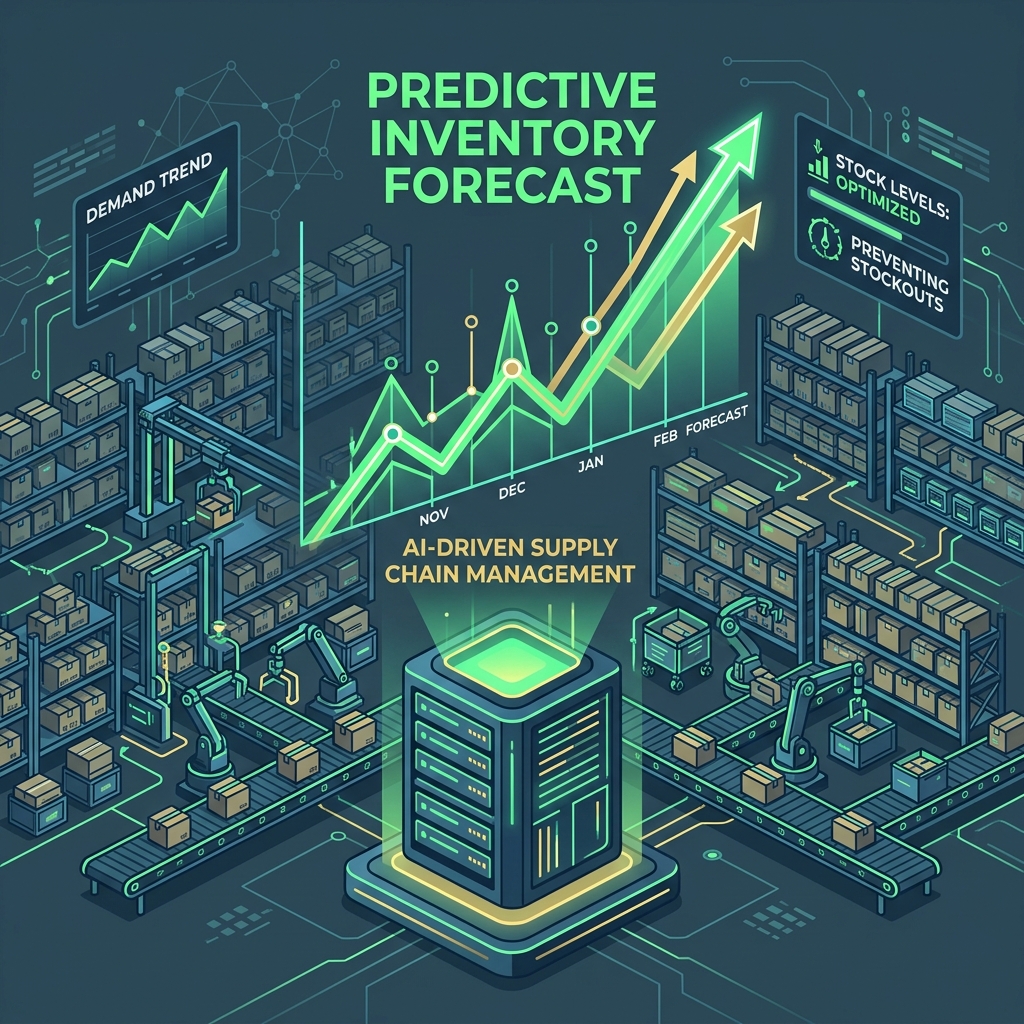
In the global supply chain and manufacturing industries, inventory management is a delicate balancing act. Maintaining excess warehouse inventory ties up critical working capital and increases holding costs, while running out of stock leads to missed sales, delayed deliveries, and frustrated customers. For businesses running high-volume distribution networks, relying on manual calculations or simple historical averages is no longer sufficient.
The solution lies in integrating machine learning predictive models directly into your custom ERP systems. By using C# and .NET telemetry engines, businesses can ingest real-time stock levels, analyze purchase trends, and predict inventory stockouts days or weeks before they happen. Implementing an AI-driven supply chain automation strategy allows logistics managers to automate replenishment cycles, optimize warehouse space, and protect profit margins.
Why Traditional Reorder Points Fail
Traditional inventory systems use static reorder points (e.g., reorder when stock drops below 100 units). However, this rule fails during sudden demand spikes, seasonal shifts, or supplier shipping delays. Predictive AI models solve this by dynamically calculating lead times and forecast demands in real-time. By utilizing compiled, high-speed C# .NET Core microservices, your custom software can analyze millions of data variables in milliseconds to adjust ordering schedules automatically.
1. The Predictive Data Ingestion Framework
To forecast inventory needs accurately, the machine learning model integrates four primary data categories from your enterprise systems:
Historical Sales Data
Analyze historical daily, weekly, and monthly sales logs over the past 3 to 5 years. This allows the predictive engine to identify long-term purchase patterns, cyclical demands, and recurring seasonal trends.
Supplier Lead Time Variability
Track actual delivery durations from multiple vendors. By feeding variable shipping times, customs delays, and transit histories into the model, the software can adjust safety stock thresholds dynamically.
Live Market & Pricing Signals
Connect external market indicators, current competitor price shifts, and macroeconomic trends. This gives the AI model the foresight to predict demand increases before they reflect in your sales logs.
IoT Real-time Stock Levels
Ingest real-time warehouse data from RFID scanners, barcode readers, and weight sensors. Continuous asset tracking prevents errors in manual log audits and ensures data precision.
2. The Automated Supply Chain Loop
Once integrated, the predictive C# telemetry system executes a continuous four-stage closed-loop workflow to manage and automate reorders:
Telemetry Ingestion
Continuous database telemetry feeds real-time transaction pings, sales numbers, and physical warehouse inventory adjustments into the system.
Predictive Processing
C# ML engines run time-series forecasting calculations over the ingested data to predict stock depletion dates for each SKU.
Threshold Detection
If the system detects that a specific product will face stockout during the supplier's lead time, it triggers a high-priority alert.
Automated Reorder
The system automatically generates a purchase order and dispatches it directly to the supplier's API, scheduling a stock replenishment.
3. Predictive AI vs. Traditional Inventory Systems
The comparison matrix below highlights the operational advantages of moving from reactive, static reorder rules to smart, predictive AI workflows:
| Operational Parameter | AI-Driven Predictive Inventory | Traditional Static Inventory |
|---|---|---|
| Forecast Accuracy | 95%+ (Continuous multi-variable adjustment) | 70% to 75% (Relies on simple static historical sales). |
| Warehouse Holding Costs | Reduced by 25% (Maintains lean safety stock levels) | High (Large bulk safety stock required to avoid runs). |
| Stockout Incidents | Near 0% (Dynamic safety stock shifts) | Frequent (During shipping delays or sales spikes). |
| Manual Labor Effort | Fully Automated API purchase triggers | High (Requires daily audits and manual purchase orders). |
ERP Tip: Start with a Simple Random Forest Model Before Moving to Neural Networks
Many development teams over-complicate AI supply chain migrations by attempting to build complex deep-learning neural networks immediately. For 90% of inventory forecasting tasks, a structured Random Forest or Gradient Boosting regression model (such as ML.NET or XGBoost) is faster to train, uses significantly fewer server resources, and delivers identical accuracy with much simpler integration.
Partner with Krista Technology to Modernize Your ERP Systems
Integrating machine learning algorithms, connecting real-time IoT database pipelines, and automating vendor purchase API workflows requires senior-level software engineers. At Krista Technology, we specialize in helping logistics, retail, and manufacturing companies build custom high-performance ERP systems with built-in predictive AI features.
If you want to integrate machine learning into your supply chain, modernize your legacy database schemas, or hire a team of dedicated Next.js & .NET developers, visit our dedicated developer hiring page today to request a CV shortlist and get a free technical estimation for your SaaS roadmap.